
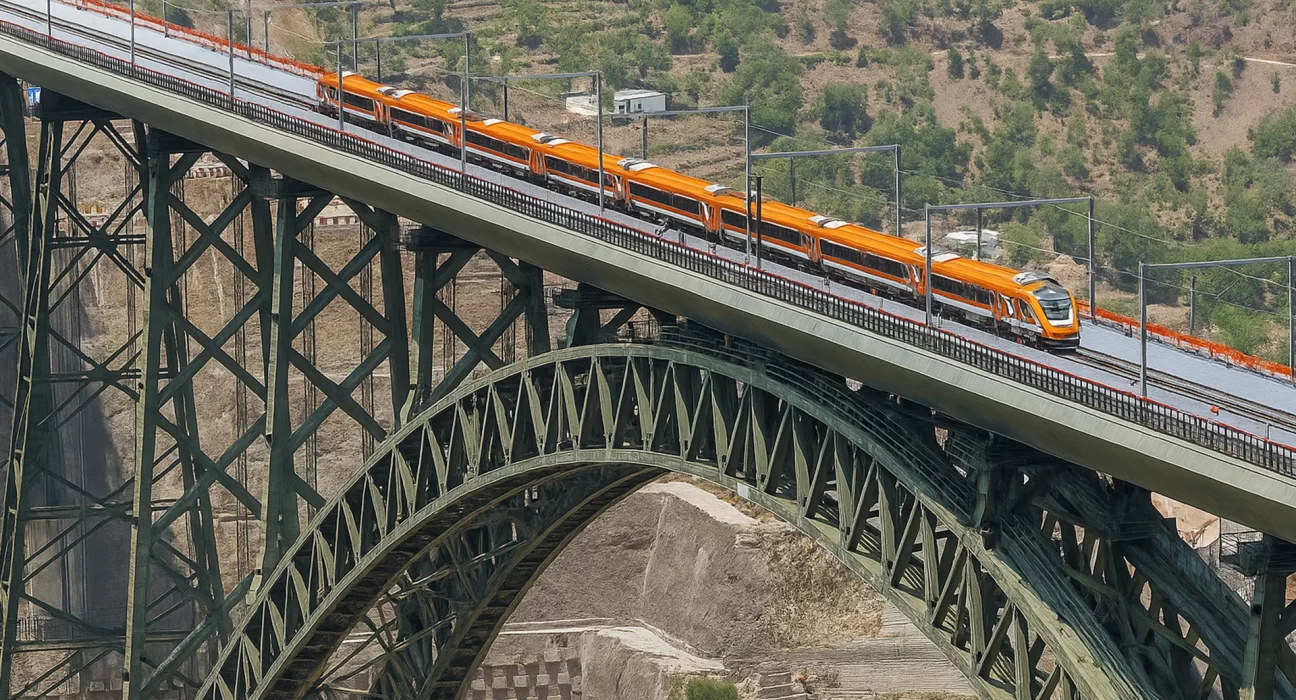
The Chenab Rail Bridge, inaugurated on 6 June 2025, is not just a bridge—it’s a symbol of India’s engineering excellence, resilience, and strategic foresight. Standing 359 meters above the Chenab River in Jammu and Kashmir, it has officially become the world’s highest railway arch bridge, surpassing even the Eiffel Tower by 35 meters. This bridge is part of the ambitious Udhampur-Srinagar-Baramulla Rail Link (USBRL) project, aimed at integrating the remote Kashmir Valley with the rest of India.
Structural Overview
| Feature | Description |
|---|---|
| Total Height | 359 meters (1,178 feet) above the riverbed |
| Length | 1,315 meters (4,314 feet) |
| Main Arch Span | 467 meters (world’s longest steel arch rail span) |
| Materials Used | 25,000 tonnes of steel and 46,000 cubic meters of concrete |
| Design Life | 120 years |
| Wind Resistance | Can withstand up to 266 km/h winds |
| Seismic Resistance | Earthquake-resistant up to magnitude 8 |
| Blast Resistance | Can endure blasts equivalent to 40 kg TNT |
| Paint | Corrosion-resistant paint expected to last 15 years |
| Monitoring | Real-time online health monitoring system |
Dr. G. Madhavi Latha, a distinguished geotechnical engineer, devoted over 17 years as a core consultant on the Chenab Rail Bridge project, one of the most challenging infrastructure feats in the world. She currently serves as a professor in the Department of Civil Engineering at the prestigious Indian Institute of Science (IISc), Bengaluru, and also chairs the Centre for Sustainable Technologies at the institute. Hailing from a modest background in rural Andhra Pradesh, Dr. Latha has risen to national prominence through her technical expertise, academic excellence, and commitment to solving real-world engineering problems. Her groundbreaking work on slope stability, foundation design, and rock anchoring was instrumental in overcoming the extreme Himalayan terrain challenges faced during the Chenab Bridge’s construction. Beyond her engineering contributions, she is a powerful symbol of women’s leadership in STEM fields in India, inspiring future generations through both her achievements and resilience.
Engineering Excellence
Constructed by Konkan Railway Corporation Ltd in collaboration with various agencies, the Chenab Bridge represents a blend of modern civil engineering, aerodynamics, metallurgy, and military-grade safety considerations:
- Arch Design: The two-rib steel arch is supported by concrete pillars and uses a combination of trusses and braces to maintain rigidity under extreme temperatures and wind conditions.
- Cable Crane Assembly: Due to the remote location and steep cliffs, a sophisticated cable crane system was used for transferring steel segments across the gorge.
- High Altitude Construction: Engineers and workers operated under freezing temperatures and unpredictable winds, ensuring safety with advanced equipment and planning.
Timeline of Construction
- 1983: USBRL project proposed to connect Kashmir via rail.
- 2002: Detailed planning of Chenab Bridge began.
- 2017: Foundation and substructure works commenced.
- April 2021: Arch closure completed, a milestone in steel arch bridge construction.
- August 2022: Deck installation completed.
- June 2024: Trial run conducted successfully using an 8-coach MEMU train.
- June 2025: Inaugurated by PM Narendra Modi and opened for passenger service.
Strategic Importance
1. Regional Connectivity
The bridge is a vital link in the 272 km USBRL project, connecting Katra to Srinagar through rugged Himalayan terrain. It eliminates the need for unreliable road travel, especially in winter.
2. Economic Upliftment
Tourism Boost: Improved access is expected to spur tourism in Kashmir, especially for domestic travelers.
Agricultural Trade: Faster transport of Kashmir’s perishable fruits like apples and cherries to national markets.
Employment: Thousands of jobs were created during the construction, benefiting the local economy.
3. National Security
The bridge allows swift movement of armed forces and logistics to border areas. It enhances operational preparedness in a geopolitically sensitive region near the Pakistan border.
Social and Symbolic Significance
Unity in Diversity: The project symbolizes national integration by connecting Jammu & Kashmir more firmly with the Indian mainland.
Architectural Pride: The Chenab Bridge has become a point of national pride, often compared to international landmarks like the Millau Viaduct (France) and the Firth of Forth Bridge (Scotland).
Tourist Attraction: The bridge has already become a landmark, with air passengers flying over it capturing photos mid-flight, as pilots highlight the structure in flight announcements.
Chenab Bridge vs Other Global Giants
| Bridge | Height Above Surface | Country |
|---|---|---|
| Chenab Rail Bridge | 359 m | India |
| Millau Viaduct | 343 m | France |
| Duge Bridge | 565 m (road) | China |
| Forth Bridge | 46 m | Scotland |
Note: The Duge Bridge is taller but carries road traffic. Chenab is the highest for rail traffic.
Chenab Rail Bridge on Google Map
Innovations Behind the Success
Remote Monitoring: A cutting-edge monitoring system checks vibrations, stress, and material fatigue in real time.
Geotechnical Reinforcement: Extra measures were taken to ensure the stability of the soil and rock base amid frequent landslides and earthquakes.
Sustainable Design: Despite its size, the bridge has minimal environmental impact thanks to careful planning and ecological protection efforts during construction.
The Chenab Rail Bridge isn’t just a piece of infrastructure—it’s a symbol of India’s determination, technological prowess, and strategic vision. As trains begin regular operation across this awe-inspiring span, the bridge will forever stand as a testament to what’s possible when ambition meets engineering brilliance.
Whether you’re a traveler, engineer, policymaker, or just a proud Indian, the Chenab Bridge will be remembered as a milestone that connected not just two riverbanks—but a region to a nation.